
Why Is My Pool Green in Bali — And How to Fix It Fast
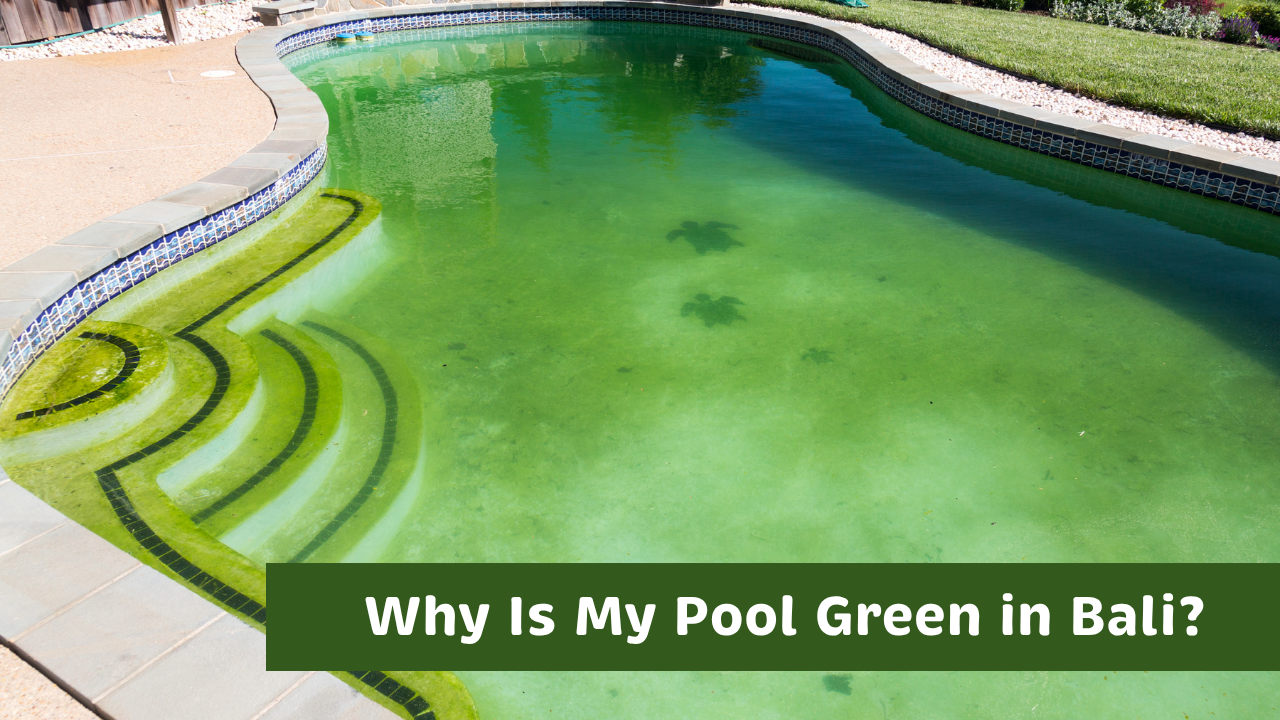
You opened your villa’s camera, or a guest sent a photo, and the pool is green. Yesterday it was fine. Today it looks like a rice paddy.
Here’s the short version: your pool is green because algae bloomed, and algae blooms when chlorine drops. In Bali that can happen in 24–48 hours — far faster than in Australia, the UK or Europe — because our heat, sun and rain gang up on your water chemistry. The good news: a green pool is almost always fixable, often within a day or two. The question is whether it’s a chemistry problem you can correct, or an equipment problem that needs a repair.
This guide walks you through both — written for villa owners managing a pool from another country, and for anyone with guests arriving who needs this sorted now.
The real reason Bali pools go green so fast
Algae spores are always in the water and the air. They’re harmless when your chlorine is holding a normal level. The moment chlorine can’t keep up, the spores multiply — and in Bali’s climate they multiply aggressively:
- Heat. Warm water burns through chlorine much faster than cool water. A tropical 30°C pool eats sanitiser far quicker than a temperate one.
- UV. Bali’s sun destroys unstabilised chlorine within hours. Without the right stabiliser level, your morning chlorine is gone by afternoon.
- Rain. A single heavy wet-season downpour dilutes your water, drops the pH and washes organic debris (leaves, frangipani, soil, garden runoff) straight into the pool — feeding the algae.
- Bather load + debris. A busy rental week, then a few days of nobody watching the water, is the classic setup for a bloom.
Put those together and you get the pattern almost every Bali villa owner eventually sees: fine on Monday, faintly cloudy on Wednesday, fully green by the weekend.
The four things that actually caused it
Nearly every green pool in Bali traces back to one of these:
- Chlorine crashed. The most common cause. The sanitiser ran out or was never dosed high enough for the heat, and algae took the opening.
- The pump or filter stopped doing its job. If water isn’t circulating and filtering, no amount of chemical will keep it clear. A tripped pump, a clogged or failed filter, or an airlock will turn a pool green even if someone is “adding chlorine.” This is the case where a green pool is really a repair, not a cleaning.
- Heavy rain overwhelmed the water. Wet-season storms dilute and unbalance everything at once, and overflow can carry garden debris in.
- The pool was left unattended. Between guests, between owners, or after a service person quietly stopped showing up. Days without circulation and dosing is all it takes.
Working out which of these it is matters, because it decides whether you’re buying chemicals or booking a technician.
How bad is it? Read the shade of green
The colour tells you roughly how far the bloom has gone and how much work it’ll take:
- Cloudy / pale green: Early. Chlorine just dipped. Often recoverable in 24 hours.
- Solid green, can’t see the bottom of the shallow end: An established bloom. Needs a proper shock, filtering and usually a couple of days.
- Dark green / you can’t see the steps: Heavy. Expect several days of treatment and continuous filtration.
- Black-green, murky, or a swamp smell: Advanced, sometimes with black algae in the plaster or tiles. This needs professional treatment and may point to an equipment failure that let it get this far.
The darker it is, the more likely the real problem is circulation — which is your cue to check the equipment before you dump money into chemicals.
Can you fix a green pool yourself?
Sometimes — if it’s caught early and the equipment is healthy. Honestly, here’s the DIY sequence:
- Confirm the pump is running and water is moving. No circulation = stop here; nothing else will work until that’s fixed.
- Clear the surface and empty the skimmer and pump baskets so debris stops feeding the algae.
- Balance the pH to roughly 7.2–7.4. Chlorine barely works if pH is too high.
- Shock the pool with a strong chlorine dose (a green pool needs far more than a normal maintenance dose).
- Run the filter continuously — 24 hours or more — and backwash or clean it as it loads up.
- Brush the walls and floor, then vacuum out the dead algae once the water clears to cloudy-blue.
- Re-test and re-dose until chlorine holds a stable level overnight. That’s the sign the bloom is beaten.
Where DIY stops being worth it: if you’re overseas, if guests arrive within a day or two, if the pool is dark green or black, or if you shock it and it goes green again — that last one almost always means an equipment fault or black algae, and it’s time to bring in a technician rather than keep buying chemicals.
When a green pool is really a repair
This is the part generic pool advice online skips. A pool that keeps going green — or won’t clear no matter how much chlorine goes in — usually has an underlying fault:
- A pump that isn’t actually circulating (tripped, airlocked, or a failing motor)
- A filter that’s clogged, channelled, or past its life and no longer trapping algae
- Plumbing or a leak dropping your water level and diluting chemistry every day
- Black algae rooted into plaster or grout, which needs mechanical treatment, not just a shock
If that’s what’s going on, the green water is a symptom. Fixing the chemistry without fixing the equipment just means you’ll be looking at green water again next week. Our Repair & Equipment service exists for exactly this — we diagnose the cause, not just the colour.
How a professional green pool rescue works
When you hand a green pool to us, the process is deliberately transparent — because most of our clients are watching from Australia, Europe or the UK and can’t stand over the work:
- Survey within 24 hours. We come out, test the water, and check the pump, filter and plumbing to find why it went green — not just that it did.
- A clear written quote before we start. No surprise chemical bills; you approve the cost first.
- Treatment: balance, shock, continuous filtration, brushing and vacuuming — plus any equipment fix the survey turned up.
- A written report sent to your WhatsApp when it’s done: what was wrong, what we did, chemicals used, and how to keep it clear.
Most single-cause blooms are back to swimmable in one to three days. Advanced or equipment-related cases take longer, and we’ll tell you that honestly up front rather than after.
How to stop it happening again — especially if you’re not here
A green pool is almost always a symptom of a gap in regular care. The fix that actually holds:
- Consistent circulation. The pump needs to run enough hours a day, every day — more in the wet season.
- Chlorine dosed for Bali’s heat, with the right stabiliser so the sun doesn’t burn it off by lunchtime.
- Extra attention through the wet season (Nov–Mar), when rain dilution and debris make blooms far more likely.
- Eyes on the water twice a week — the single most reliable prevention, and the reason a green pool almost never happens on a maintained contract.
If you manage the villa remotely or rent it out, the real problem a green pool exposes is that you have no proof the pool is being looked after. That’s precisely why our pool maintenance includes a written report after every single visit — so you know the water is fine before a guest ever tells you it isn’t. We cover Bali’s main villa areas including Canggu, Seminyak, Ubud, Uluwatu and Sanur.
Green pool right now? Get a same-day survey
If guests are arriving or you just want it gone, don’t wait for it to get darker — the sooner it’s treated, the cheaper and faster the fix.
Message us on WhatsApp for an urgent green pool rescue → We survey within 24 hours, send a clear quote before starting, and report back to your WhatsApp when it’s clear.
Frequently asked questions
How long does it take to fix a green pool in Bali? A pool caught early — pale or cloudy green — is often clear within 24 hours. A solid or dark green pool usually takes two to three days of shock treatment and continuous filtration. Black-green or equipment-related cases can take longer, and a proper survey will tell you which you’re dealing with before any work starts.
Is it safe to swim in a green pool? No. Green water means algae, and where algae grows, bacteria follow. It also hides the pool floor, which is a drowning and slip risk. Keep everyone out until the water is clear and chlorine is holding a normal level.
Why does my pool keep turning green even after I add chlorine? Usually one of three things: the pool isn’t circulating properly (a pump or filter fault), the pH is too high for the chlorine to work, or there’s black algae rooted in the surface. If chemicals aren’t holding, it’s almost always an equipment or structural problem — worth a survey rather than more chemicals.
Why do Bali pools go green faster than pools back home? Heat, strong UV and rain. Warm water and sun burn through chlorine within hours, and a single wet-season downpour dilutes and unbalances the whole pool while washing debris in. It’s why a pool here can go from clear to green in a day or two, far faster than in a cooler climate.
Can I prevent a green pool while I’m overseas? Yes — with consistent, twice-weekly professional care and correct dosing for the climate. The reason blooms happen to remote owners is that no one is watching the water between guests. A maintenance contract with a written report after each visit closes that gap.
Hendra Mawlid
Pool specialist · Bali Pool CarePool specialist with 8+ years across Bali, Lombok, and Nusa Penida. Founder of Bali Pool Care.